Hybrid Computing
Quantum + classical algorithms
Hybrid architectures can use classical and quantum resources together, with algorithms directing decisions, data analysis and physical systems.
Matter is anything that has mass and occupies space. At DeTection Inc., “matter” refers to physical substances and materials—including solids, liquids, gases, and biological materials.
Our Matter Intelligence technology is being developed to detect, characterize, and organize observations of physical matter into structured, machine-usable information.
DeTection Inc. develops hybrid quantum and classical algorithm systems for automated robots and drones, combining autonomous physical procedures with matter detection, standardized environmental observation and data-driven analysis of individual matter and associated matter clusters.
Environmental • Agriculture & Greenhouses • Food Processing • Medical
The platform is designed around hybrid quantum and classical computing methods that can support self-directed automated drones and robots. In medical applications, the goal is to combine robotic procedures with fast detection of abnormal cells and other target matter using UMMDA technology. Environmental applications include the development of automated systems for detecting and characterizing toxins, contaminants, and other potentially hazardous matter in air, water, and soil using UMMDA technology.
DeTection Inc. is developing a proprietary database of Matter Vectors—structured representations of clusters of physical matter and their measurable characteristics, associations, locations, and movement over time. By identifying patterns, tracking where matter originates and how it moves, the system is being designed to support forecasting of potential future events and environmental changes.
Beyond detection and forecasting, DeTection Inc. is developing biosurfactant-based technologies intended to help eliminate a range of environmental contaminants and biological threats in both indoor and outdoor environments.
Hybrid architectures can use classical and quantum resources together, with algorithms directing decisions, data analysis and physical systems.
Autonomous mobility enables drones and robots to support sensing, inspection, material collection, monitoring and selected automated procedures. Separately, the observation and analysis of motility in biological matter may help characterize movement patterns, behavior and changes over time, subject to validation.
DeTection Inc.'s Matter Intelligence architecture is being developed to support autonomous robotic and drone-based systems, fixed sensing installations, and manually operated applications. This flexibility allows users to select an acquisition method appropriate to their environment, operational requirements, and available resources, while using a common framework for matter characterization and data analysis.
Traditional manual sampling can introduce additional handling and opportunities for contamination or inconsistency. DeTection Inc. is developing drone- and robot-based sampling methods designed to reduce unnecessary handling, minimize contamination risks, and preserve sample integrity. More consistent, higher-quality observations are intended to strengthen the Matter Vectors database and support more reliable analysis and forecasting.
Better sample integrity. Better data quality. Better Matter Intelligence.
UMMDA is being developed to identify targeted substances, microorganisms and abnormal cells in applicable environments. The apparatus is designed to let users adjust detection sensitivity, resolution and analysis parameters to suit application needs, with trade-offs in processing time and operational requirements. Actual accuracy and performance depend on validation and operating conditions.
DeTection Inc. couples its autonomous robotics concepts with patent-pending UMMDA technology for detection of matter and microorganisms. UMMDA is intended for applications spanning medical, residential, commercial, industrial and environmental settings.
Explore the dedicated UMMDA website for the matter-detection platform and its applications.
Referenced application family: USPTO 18/141,374 and PCT/US2023/020501.
The technology is being developed for automated detection and selected robotic applications across multiple environments. Specific implementations depend on the target matter, sensing method, robotic platform and regulatory requirements.
Selected automated medical applications combining robotic procedures with rapid detection of abnormal cells and other target matter.
Automated detection concepts for toxic or unwanted matter in indoor residential and commercial environments.
Robotic and drone-based monitoring concepts for agricultural, greenhouse and farming environments.
Automated detection and monitoring concepts for food-processing environments where rapid identification of targeted matter may be useful.
Mobile robotic and drone systems for monitoring water, air, surfaces and other environmental conditions, with potential standardized collection of spatial and temporal matter observations.
Potential field-of-use licensing for municipalities, educational institutions and other organizations seeking automated robotic detection solutions.
Many environments need more than identification of an isolated particle or microorganism. DeTection Inc. is developing concepts for characterizing associated clusters of matter — for example, biological material found with fibers, fragments or other environmental matter — and recording those observations across time and location.
Rather than treating every detected item as an unrelated observation, the system can preserve information about matter found together, creating richer signatures for research, monitoring and source investigation.
Automated observation and collection can support repeatable procedures at scale while reducing human-introduced contamination and sampling variability. Specific collection and sensing methods depend on the application and require validation.
Repeated observations may reveal associations among locations and matter clusters and support investigation of candidate deposition or movement vectors such as air, footwear, clothing, equipment or other pathways. Such associations do not by themselves establish causation.
Standardized observations can create structured records describing matter identity and characteristics, cluster composition, time, location, environmental context and recurring patterns. At scale, this database may support monitoring, analytics, research collaborations, licensing and other commercial data applications, subject to validation, privacy, regulatory and contractual requirements.
DeTection Inc. is open to licensing discussions for countries, territories, educational institutions and municipalities for automated robotic matter detection and selected automated medical applications. Rights, exclusivity, field of use, territory and commercialization terms are subject to a definitive written agreement.
DeTection Inc. implemented and executed an initial medical/biological classification workflow using Quandela’s MerLin framework in perfect simulation. The benchmark used the publicly available Breast Cancer Wisconsin (Diagnostic) dataset to test a reproducible photonic quantum computing pipeline before progressing toward noise modeling and quantum hardware.
Both the 2-photon and 3-photon FidelityKernel configurations achieved 97.5% accuracy on the held-out 40-case test subset.
The 2-photon Quantum Reservoir Classifier achieved 97.5% test accuracy; the 3-photon configuration achieved 95.0%.
The experiment used 6 PCA-reduced features, 80 training cases and 40 test cases, with perfect simulation (shots=0).
DeTection Inc.'s intellectual property portfolio includes granted patents and pending patent applications covering aspects of its technology. Individual patent grants and applications should be verified against the patent docket; publication of an application does not itself mean a patent has been granted.
USPTO Application 18/141,374
Published as US 2023/0375583 A1 ↗
Download Publication PDF (external source) ↗
WIPO Application PCT/US2023/020501
Published as WO 2023/224791 A1 ↗
Download Publication PDF (external source) ↗
USPTO Application 19/532,226
U.S. application filed; described by the company as not yet published.
WIPO Application PCT/US2026/014456
Published as WO 2026/198182 A1 ↗
Backup: View Published Application PDF ↗
Two rebranded concept animations, followed by actual liquid-system and AI microscopy prototype recordings. Historical branding may be visible in original footage.
Video 1 of 4 · Original video included for local playback.
Video 2 of 4 · Original video included for local playback.
Video 3 of 4 · Original video included for local playback.
Video 4 of 4 · Original video included for local playback.
These four thumbnails are frames extracted from the four supplied videos. Original field and laboratory photographs can be added when supplied.

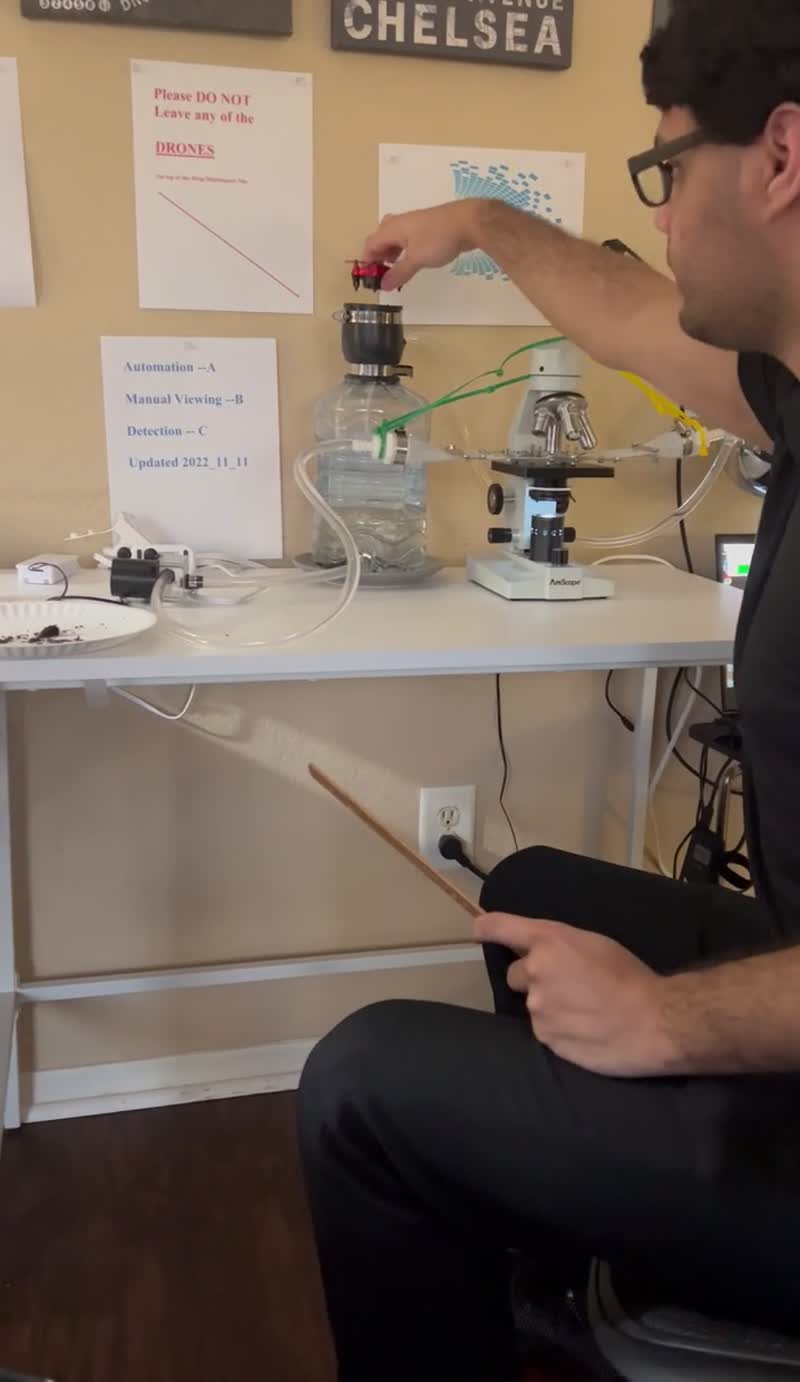
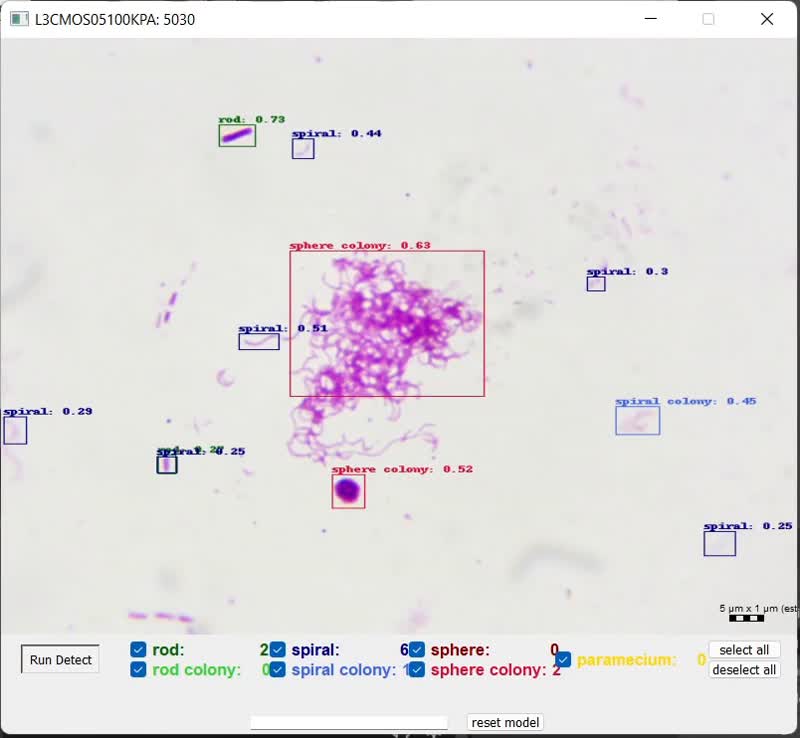
Recorded interfaces and demonstrations do not establish independently validated organism identification, autonomous field deployment or treatment efficacy.
The inventor and founder transferred all intellectual property (IP) and trade secrets to DeTection Inc. Research and development previously conducted through predecessor companies, including DE3 Inc., was also transferred to DeTection Inc.
DeTection Inc. is the current corporate entity responsible for continued development, protection, commercialization and licensing of the technology.
The company maintains proprietary know-how, confidential research methods and trade secrets. This public presentation does not disclose protected details.
For worldwide licensing, technology collaboration, research, educational or municipal inquiries, contact DeTection Inc.